

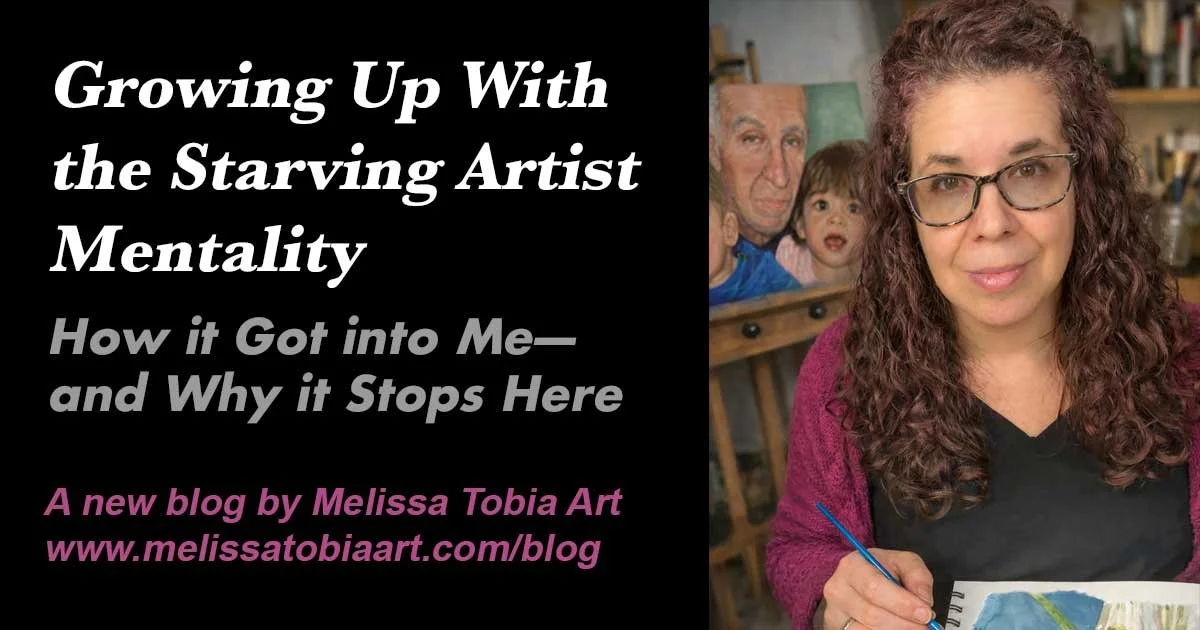
Growing Up With the Starving Artist Mentality
I was sixteen when my economics teacher used being an artist as a cautionary tale.
He was listing careers that leave you broke. Jobs that don't make money. And he said artist like it was fact. I sat there, insulted, thinking, what does he know about art, or whether artists can make money? I dismissed him in my head, though it angered me.
But here's the thing about being sixteen in the '80s. There was no internet. No feed full of people quietly making a living from the exact thing he'd just called a dead end. So even as I dismissed him, part of it got in.
That's how contagions work. They don't announce themselves, they get passed to you — through brainwashing, unwanted advice, whispers about you, the stories we read and watch. It's in our culture, and people think they are doing you a favor.
How it got into me — and why it stops here.
I was sixteen when my economics teacher used being an artist as a cautionary tale.
He was listing careers that leave you broke. Jobs that don't make money. And he said artist like it was fact. I sat there, insulted, thinking, what does he know about art, or whether artists can make money? I dismissed him in my head, though it angered me.
But here's the thing about being sixteen in the '80s. There was no internet. No feed full of people quietly making a living from the exact thing he'd just called a dead end. So even as I dismissed him, part of it got in.
That's how contagions work. They don't announce themselves, they get passed to you — through brainwashing, unwanted advice, whispers about you, the stories we read and watch. It's in our culture, and people think they are doing you a favor.
HOW IT SPREAD

Image from Unsplash, courtesy of Towfiqu Barbhuiya
My teacher was just a carrier of this disease. I grew up with — find a job, work hard, and support your family. There was no going after your dreams. It was about making ends meet, putting food on the table. Survival. Being an artist was not a lifestyle of survival. It was an occupation that was frivolous.
When I started thinking about college, my parents pushed hard for me to major in business. Made it clear they wouldn't pay for me to major in art. (There was a business-like haircut involved. I still regret it.) So I got clever — I came back with "computer art" and "graphic design," and I sold it to them as the business of art. I had no idea what I was talking about. I genuinely believed graphic design was just… doing art on a computer. Not to say that you can't, I know plenty of digital artists, but in my case, it wasn't.
Then there was the supermarket. I worked as a cashier while going to college. A guy I knew there — a little older, an artist — was bagging groceries at my register, and we would often talk about art and my college plans. He talked about his experiences of being an artist, his struggles. One of those times, our conversation was overheard by another cashier. Though she wasn't part of the conversation, since she happened to be standing next to him, she made a face, a little gesture, and stated that artists starve. According to her, I was doomed to a life of poverty and struggle. She shrugged and reminded us of the starving artist term.
I didn't want to believe her, but subconsciously, I took it in. Of course I did. Everyone was saying the same thing. The artists I could see were struggling. And I had this idea in my head that the ones who "made it" had either come from money and never had to worry, or they were just golden. Lucky. Chosen. Not me.
So I did the responsible thing. I became a graphic designer. To me, it was better than majoring in business like my parents wanted.
THE COMFORTABLE BUT MISERABLE CAGE

Image from Unsplash courtesy of Israel Andrade
For thirty years, design paid my bills. Fifteen of them at one company.
I want to be fair to it, because it wasn't a waste. Those are real skills, and they're mine now — I use every one of them for my own art business today. That job put food in my kids' mouths and a roof over our heads. Did I love it? No. Did I like it? Sometimes. There were stretches I enjoyed. If I had a job I didn't hate, I counted myself lucky.
But I never loved it. I tolerated it. And every single time I had to put my art down to go do it, I felt the resistance. That's the part nobody warns you about — the cage isn't always miserable, it's mostly comfortable. Not comfortable like your bed at the end of a long day — comfortable like slowly wasting away, bored out of your mind, but too safe to leave that steady paycheck. It feeds you just enough that leaving feels ungrateful and dreams feel unrealistic. You tell yourself you're lucky it isn't worse, and you stay another year. And another. It's easy to stay, it gets harder and harder to leave that security. Because you're a grown-up now, with responsibilities and bills, and this is what grown-ups do.
Somewhere in those thirty years, I stopped needing anyone else to say "starving artist." I said it to myself.
THE DAY I HAD ENOUGH OF IT
Image from Unsplash courtesy of Elijah Potter
It was at the old office, sometime before 2015. I wasn't even trying to be a full-time artist back then — the idea wasn't even a consideration.
A creative director from another brand stopped in the hallway by my desk. She was talking about her daughter, who I gathered wanted to be an artist. And she said — about her own child — that trying to make a living as an artist is impossible, and she wouldn't recommend it.
My blood boiled. It took everything I had not to say something. I sat there and I bit my tongue and I liked her a lot less after that. In fact, every time I saw her again after that, I thought about that and was further enraged. I had enough of that mentality.
But something shifted in me that day, quietly. Because this wasn't a bitter teacher who "didn't know art." This was a creative director — someone whose whole career is proof that art and a paycheck can live in the same room — handing the exact same poison to her own kid. I wondered if she too had dreams that she gave up, a victim of the same poison. And I thought: enough is enough. No more. We have to get rid of this thinking.
For years I couldn't act on it. But that was the day I finally saw it for what it is. Not an opinion. Not wisdom. A contagion — passed down, from generation to generation, like a disease through people who believe they're protecting you.
WHAT FINALLY CHANGED
First, COVID cracked it wide open. The whole world stopped, people lost their jobs, and a lot of them picked up a brush to fill the time. Some had never made art in their lives. And a chunk of them went from hobby to actually making a living at this — people who didn't even know they were artists until they tried. I watched it happen on social media.
And still — still — I told myself they must have a secret I didn't have—a massive following? Luck?
But here's what I finally understood, and it's the whole thing: there was no secret. Social media only ever shows you the highlights. Nobody posts their failures, the in-between, the struggle. They make everything look easy, flawless, scripted, perfect. I was comparing my behind-the-scenes to everyone else's highlight reel — and then using the gap as proof I couldn't do it. That comparison was rigged from the start. And comparing yourself to other artists and their successes is the recipe to impostor syndrome.
I learned the lesson of— you are not in competition with other artists — only with yourself.
Once I learned that, I stopped comparing.
Once I learned that lesson, I spent a long time working on my confidence and my beliefs. I stopped being someone who hoped she could and became someone who decided she would.
Second, in December 2025, I lost my job.
It was a dream come true. My husband was on board completely. When I told some family members, I braced for the old "find something more realistic" speech — and instead they were supportive. Sort of. The line "well, if it doesn't work out, at least you tried" came up more than once. Which tells me the disease is still in them, too. Just wearing a kinder costume.
WHERE I ACTUALLY AM RIGHT NOW
I'm going to be honest with you, because the whole point of this is about the journey, the risk I am taking. This story doesn't end with me having a six figure income, a massive social media following and me telling my family members who doubted me—I told you so. It ends unresolved, things still in motion. Things still happening. What I haven't told you is that the funny thing is, the night before I was let go, I asked the universe how I was ever going to make this transition, from this demanding job? It was never going to allow it. The answer came the following morning with the layoff.
This story has not ended. I'm standing in the middle of that climb to my own success.
Ready to grab what is mine.
Since I lost my job, I've been building the foundation — using every resource I can get my hands on. The SEAP program through unemployment. The SBDC advisors. The training. I am doing everything in my power to make this real.
And I've made a lot of mistakes already. My website started off being too complicated because I let the designer in me take over. Charging way too little for my work. I can not stress enough the importance of having a real business plan and marketing strategy. I fully expect to make more.
Though I'm even making less art right now than I want to — and I hate that. I left a job that starved my art of time, and for the moment, building my art empire is taking some of my art time also. But temporarily. On purpose. Because I'm building a system that finally gives the art its time back forever.
That's the sacrifice nobody sees. I'm betting my confidence against the real risk of failing out loud. My family has less money coming in until it turns. That's what "sacrificing everything" actually means. Not everything. But enough that it's real. At my age (53), I feel like it is really now or never to accomplish my dreams. But I am reminded of artists that had a late start like Grandma Moses.
WHY I WON’T STOP
Image from Unsplash, courtesy of Towfiqu Barbhuiya
The biggest reason is the simplest one: I want this. I can taste it.
My art has always mattered more to me than anything I've done for a paycheck, and I've fantasized about this life for longer than I've admitted out loud. I don't need a noble excuse to chase it. Wanting it is enough. Art has always been there for me through the hardest times and I am genuinely in love with it. I never want to stop.
I have kids that are watching how I handle grown-up things like wanting something badly and starting a business.
I'm not afraid to make mistakes — I expect them. They're the best teachers I've got. What I'm afraid of is my kids not even wanting to try and just settling, because someone convinced them they couldn't, or that you can't make a living doing what you love. I took in that mentality at sixteen. I carried it for thirty years. I am not handing it down.
The negative thinking, the limiting beliefs, the mentality — they stop with me.
So here's my vow: I will no longer buy in to an inherited way of thinking, this contagion.
I have to make it. I am sacrificing for it. I won't stop until I do. This is my passion, and I want what I want — and I'm going to get it, one way or another.
I'm not promising a fairytale. I can't even say what the timeline will be. But I can promise you'll see the real version — the failures, the marketing experiments, the days it doesn't work — right alongside the wins. Because that's the whole point. Somebody has to show future generations that the starving artist is just a myth; let's replace it with a thriving artist.
If you grew up with this same lie in your head — if there's a teacher, or a parent, or a stranger in a supermarket still living in your head —
tell me about it.
Drop me a comment about your experience with the starving artist mentality and how it affected you, or come follow my journey on social media and my website. I'm documenting all of it: the wins, the failures, and the struggle in between.
Let's prove them wrong together.
-
August 2024
- Aug 14, 2024 Coping with Anxiety through Art, Spirituality and Energy Healing: My Journey To Find Peaceful Solutions Aug 14, 2024
-
June 2026
- Jun 30, 2026 Starting Over at 53: How I Became a Full-Time Artist (and the Free Help No One Told Me About) Jun 30, 2026
-
July 2026
- Jul 4, 2026 Growing Up With the Starving Artist Mentality Jul 4, 2026